I wanted to create an image that would change depending on how it was held, engaging with light and translucency. In past handmade paper projects I have focused on using the blowout method, however, for this piece I chose to create the bodice as a watermark in order to achieve a “reverse blowout.” In doing this, the gauzy cotton overlay of the corset watermark evokes the sheer quality of lace enhancing the materiality of the piece. It allows the pulp painting on the back to show through and lures a reader to flip the print. I am frequently thinking about surface and tactility, which is why I used two different fibers to further the conflict between lure and snare.

Editioning handmade paper is always a process of troubleshooting, in this case figuring out how to order different layers of the print so as to laminate the two sheets together. I pulled the cotton sheet without a deckle to enhance the translucency of the watermark and because the design was so precarious I couched on top of the abaca sheet (taking advantage of its gelatinous surface to get the corset to stick). Embedding the pulp painting between the sheets entraps the lace drawing at the center and enhances the visibility of the design in the foreground.

Insidious Delicacy (2020) Pulp painting and watermarks on handmade paper (cotton and abaca). Each panel is 11” x 17,  full piece is 24” x 35” when framed. 


Edition of 125. All handmade paper.

This print was created as part of Hand Papermaking Portfolio #14: The Language of Color. For the call, artists were asked to respond to the question: “What does color mean?”

Below is an excerpt from the essay accompanying the portfolio, written by Bridget Donlon and published in Hand Papermaking Magazine, Volume 38, Number 1, Summer 2023:

“Language itself is subject to interpretation and can be given alternative contexts. With Henceforth, Sue Carrie Drummond draws upon elements of Nathaniel Hawthorne’s 1850 The Scarlet Letter to reflect upon the perpetually complex nature of femininity and outdated but persistent expectations to perform it in public. A beautiful gradient from a cherry red to a dark charcoal black is the base of a misty veil of watermarked lace, a material that is paradoxically strong despite its delicate appearance. The waxy surface resembles votive candles that have melted and pooled, alluding to ecclesiastical rituals and adornments. The use of specific colors and patterns combine to signify social mores, structures, and other myriad associations.”

The portfolio is held in several permanent and private collections, including The Thomas J. Watson Library at the Metropolitan Museum of Art. For more information or to purchase, click HERE.

Henceforth (2021) Watermarked overbeaten cotton on red-and-black cotton base sheet, letterpress printing, beeswax. 8”x10”
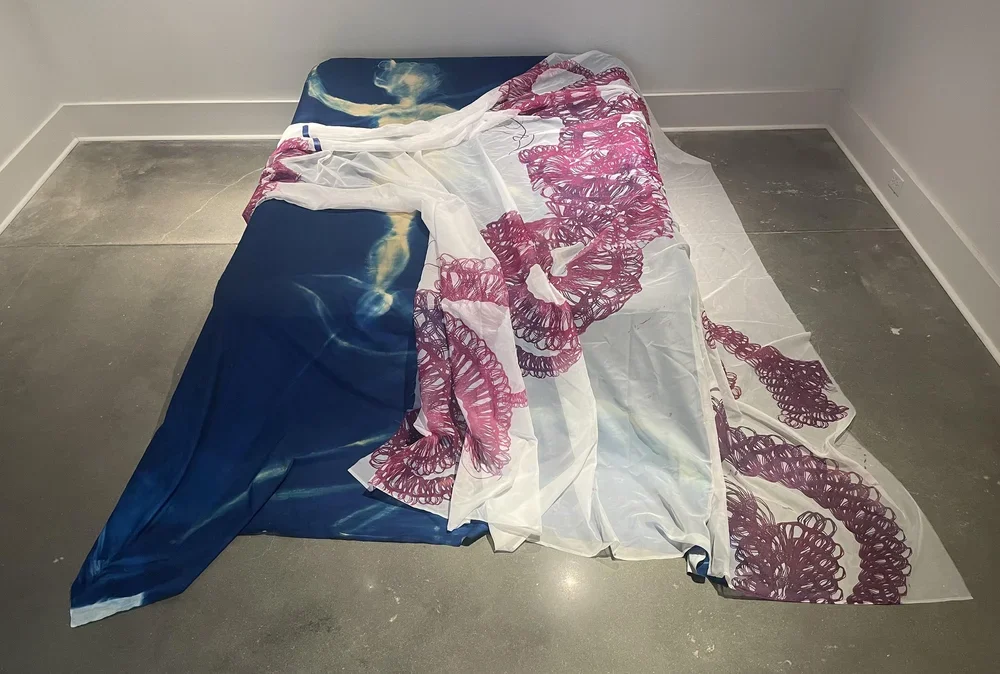
This piece was an experiment in bringing the body more tangibly and dimensionally into my work. Using my own body and the sun, I created the cyanotype image, then toned it with sodium bicarbonate to deepen its visual texture. A layer of voile rests above the print, patterned with large-scale lace designs that reach toward the figure, partially obscuring it. The figure seems caught in a quiet tension—hovering between the urge to slip free and the comfort of staying tucked beneath the veil—much like the way we navigate the expectations we place on ourselves.

Underlying (2023) 54”x75”x10”Screenprint on voile and cyanotype on cotton. Prints are installed over a full sized inflatable mattress. 


This series of prints explores the gaze—how we offer it, withhold it, and internalize it. Each cyanotype is based on photographs I once sent to my partner during a period of long distance. Revisiting them, I realized I had cropped out my eyes in every image, subconsciously avoiding my own gaze—unwilling to confront myself while consuming my own body. Layered with sewing diagrams, these prints evoke the idea of "blueprints," hinting at the invisible patterns—desire, shame, longing—that shape our gestures and guide our performances, often without our full awareness.

Sample Pattern(2021), Cyanotype on cotton with screenprint and stitched handmade paper. Stretched over wood frame. 17" x 22"


This print was created for the portfolio exchange Earth Mother, organized by Elizabeth Castaldo.

The piece explores nature’s connection to the feminine spirit, especially in the context of exile and self-discovery. I was thinking of The Scarlet Letter as I worked—the way the forest becomes a refuge for Hester once she is cast out of Puritan society. Hawthorne writes:

“She had wandered, without rule or guidance, into a moral wilderness as vast, as intricate, and shadowy, as the untamed forest […] Her intellect and heart had their home, as it were, in desert places, where she roamed as freely as the wild Indian in his woods…”

In the unclaimed wilderness, Hester is free to shed social constraints and let her inner desires expand. This print honors that unruled space.

A Moral Wilderness (2020) Cyanotype and screenprint. 11” x17”

In this work I explore the historical use of women as vehicles for the exchange of property and wealth between men through marriage dowries. It was part of an exhibition at the Lauren Rodgers Museum (in Laurel, MS) titled Collections Interventions. Artists were invited to choose a work from the permanent collection as inspiration for making a new piece. I chose a candelabra from the British Georgian Silver Collection because of its material tie to bridal gifts and affluence. Using design features from the candelabra, I built a female figure out of lace which is printed on separate sheets of translucent handmade paper. These sheets overlap one another to evoke the sense that the figures (i.e. objects) are inconsequential and interchangeable.

This piece was purchased by the museum and is now a part of the LRM permanent collection. 

A Dowry (2020)  Screenprint on overbeaten handmade abaca, layered paper. 21” x 28”


This series considers how women must alter themselves during the process of marriage in order to fit into the expectations of a Wife. The lace garments in the foreground represent bridal clothes, the preparations for the upcoming wedding day. While the sewing patterns in the background act as a foundation for the garments, the expectations and designs a bride is expected to conform to in order to become a Good Wife.

Alterations (2019) Handmade paper with cotton blowouts on overbeaten abaca with screenprints. Series of 6 prints, all 16” x 20.“


This series of prints explore the potential of clothing as a signifier for skin. Shirts, sweatpants, and jackets allow us to re-experience past moments or sensations: the embrace of a parent, the comfort of a friend, the caress of a lover. Throughout this series I examine the wear and tear on my garments, suggesting the absence of the person to whom the clothing was connected.

The titles of each print function as a narrative:

1. A loan never meant to be returned

2. A dress I wore for him

3. I wore them out walking the city with you

4. The zipper broke, the lining ripped, and he passed away

5. When you were away, I kept it to inhale your scent

6. My mother couldn’t mend it

7. You never liked it anyway

Worn (2014) Monotypes on Arches 88, each print is 11” x 14”